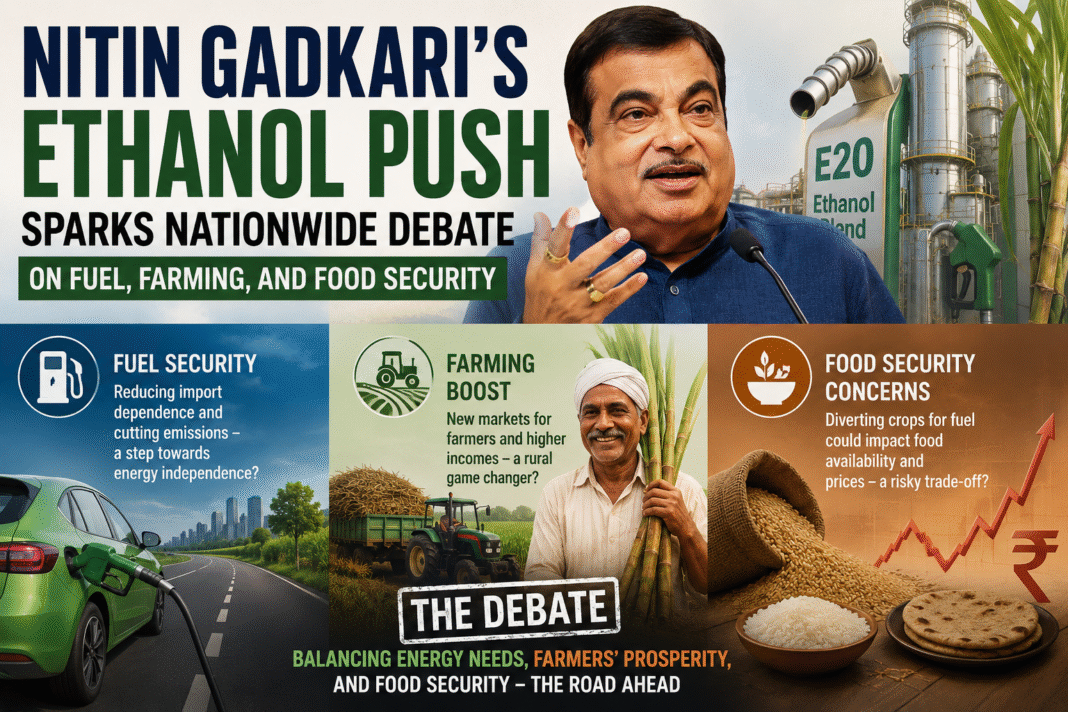
India is moving steadily towards cleaner and more sustainable sources of energy, and one of the biggest steps in that direction is the promotion of ethanol-blended fuel. Over the past few years, Nitin Gadkari Ethanol initiatives have become a major talking point across the country. Union Road Transport and Highways Minister Nitin Gadkari has repeatedly highlighted ethanol as a solution that can reduce India’s dependence on imported crude oil, increase farmers’ income, and help cut pollution.
While many experts and policymakers support this vision, the rapid expansion of Ethanol Blending India has also triggered an important national discussion. Economists, environmentalists, farmers, and industry experts are debating whether using food crops to produce fuel could eventually affect agriculture, water resources, and Food Security India.
So, is ethanol the future of clean transportation, or does it come with hidden challenges? Let’s take a closer look.
Why Is India Focusing on Ethanol?
India imports a large share of the crude oil it consumes, making the country vulnerable to rising global fuel prices. To reduce this dependence and improve energy security, the government introduced an ambitious Ethanol Policy India, encouraging the use of ethanol-blended petrol.
Ethanol is a renewable fuel produced from sugarcane, maize, damaged food grains, and agricultural waste. Unlike conventional fossil fuels, ethanol burns cleaner and produces fewer harmful emissions.
According to Nitin Gadkari Ethanol supporters, increasing ethanol production offers several long-term benefits. It can reduce oil imports, lower pollution, strengthen India’s energy security, and create additional income opportunities for farmers.
For many policymakers, ethanol represents a win-win solution for both the economy and the environment.
What Is Ethanol Blending India?
The Ethanol Blending India programme involves mixing ethanol with petrol before it reaches fuel stations. The government’s long-term goal is to increase the percentage of ethanol blended into petrol, helping reduce the country’s reliance on fossil fuels.
Oil marketing companies purchase ethanol from sugar mills and grain-based distilleries before blending it with petrol supplied across India.
The programme has encouraged investments in biofuel production and opened new business opportunities for the agricultural sector.
Why Has the Fuel vs Food Debate Started?
As ethanol production continues to grow, so has the Fuel vs Food Debate.
The main concern is simple—if food crops such as maize and sugarcane are increasingly used to produce fuel, will there be enough food available for people and livestock?
Many experts believe this question deserves careful attention.
They warn that if farmers receive better returns from ethanol production, they may prefer cultivating crops used for biofuel instead of essential food crops. Over time, this could affect food availability and even increase food prices.
Supporters, however, argue that India’s ethanol programme mainly uses surplus sugar and excess grains that are not required for regular food consumption.
This difference in opinion has made the Fuel vs Food Debate one of the most discussed issues in India’s clean energy journey.
Food Security India Remains a Key Concern
Whenever fuel is produced from food crops, questions about Food Security India naturally arise.
India is home to more than 1.4 billion people, and ensuring affordable food remains one of the government’s biggest responsibilities.
Some agricultural experts believe that diverting edible crops towards ethanol production could become risky during years of poor rainfall or lower agricultural output.
Others worry that if ethanol demand continues to rise, farmers may gradually shift away from cultivating pulses, vegetables, and other essential crops.
On the other hand, government officials maintain that ethanol production primarily uses surplus agricultural produce and damaged grains that are not suitable for human consumption.
The challenge is finding the right balance between energy needs and food security.
Water Usage Is Another Important Issue
Apart from food security, water consumption has become another major point of discussion under the Ethanol Policy India.
Sugarcane, one of the primary sources of ethanol, requires a significant amount of water to grow.
Environmental experts caution that increasing sugarcane cultivation in drought-prone regions could put additional pressure on already stressed groundwater resources.
To address this issue, many experts suggest promoting second-generation ethanol made from agricultural waste instead of edible food crops.
Such an approach could reduce pressure on both food supplies and water resources.
Farmers See New Opportunities
While concerns exist, many farmers view Nitin Gadkari Ethanol initiatives as a positive development.
The growing demand for ethanol has created an additional source of income for sugarcane growers and grain producers. Stable demand from ethanol manufacturers has also helped improve payment cycles for farmers.
Supporters believe the programme can strengthen rural economies by creating jobs, increasing farm income, and generating value from agricultural waste that would otherwise go unused.
For many farmers, ethanol is not just about fuel—it’s about better financial stability.
Environmental Benefits Cannot Be Ignored
Supporters of Ethanol Blending India also point to its environmental advantages.
Compared to conventional petrol, ethanol produces lower carbon emissions and helps reduce air pollution.
It also supports India’s broader commitment to cleaner transportation and reducing greenhouse gas emissions.
However, experts agree that environmental benefits should not come at the cost of food security or unsustainable farming practices.
A balanced approach is essential.
What Do Experts Recommend?
Interestingly, most experts are not against ethanol itself. Instead, they believe the Ethanol Policy India can be improved through smarter planning.
Some of their key recommendations include:
- Expanding ethanol production from agricultural waste.
- Reducing dependence on edible food grains.
- Promoting drought-resistant crops.
- Improving irrigation techniques.
- Closely monitoring food prices.
- Ensuring that Food Security India remains protected.
These steps could help India enjoy the benefits of clean energy without creating unnecessary pressure on agriculture.
The Road Ahead
India’s transition towards cleaner fuels is expected to continue, making Ethanol Blending India an important part of the country’s future energy strategy.
At the same time, the ongoing Fuel vs Food Debate reminds policymakers that energy security and food security must go hand in hand.
The success of Nitin Gadkari Ethanol initiatives will ultimately depend on how effectively India balances environmental goals, farmer welfare, and the need to protect Food Security India.
Conclusion
The discussion surrounding Nitin Gadkari Ethanol initiatives reflects a much larger conversation about India’s future. Ethanol has the potential to reduce fuel imports, cut pollution, and improve farmers’ livelihoods. At the same time, the concerns raised through the Fuel vs Food Debate cannot be ignored.