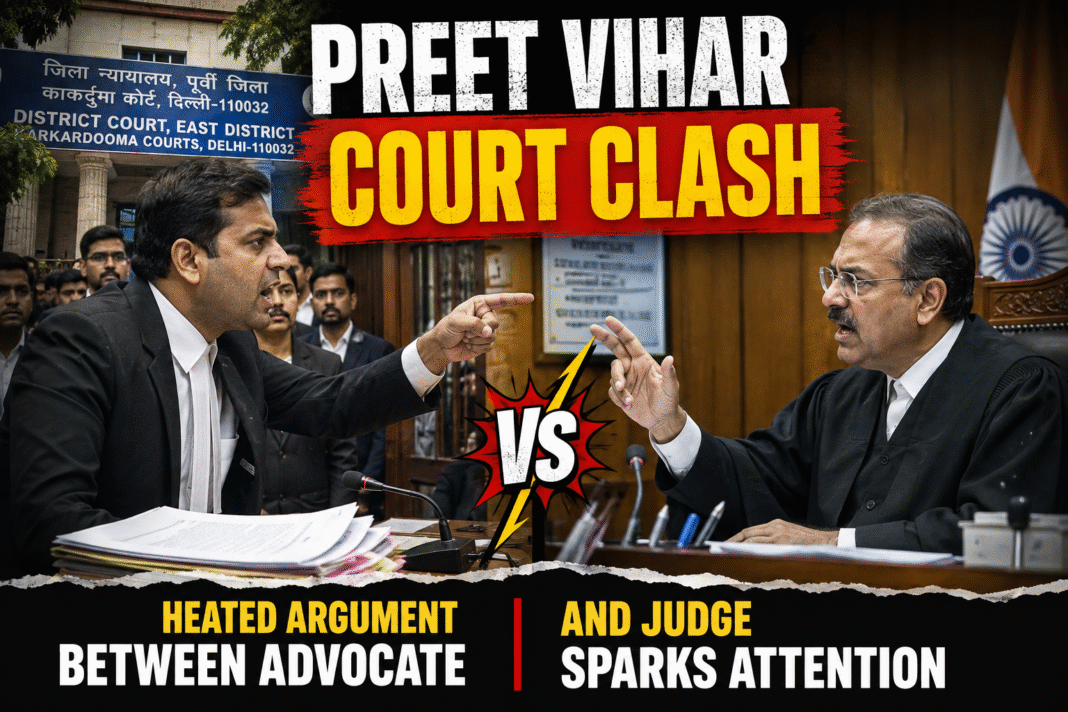
A heated argument between an advocate and a judge at a court in Delhi’s Preet Vihar area has attracted attention and sparked discussion about courtroom discipline, professional conduct and the importance of maintaining dignity during legal proceedings.
The reported Preet Vihar Court Clash took place during court proceedings, where an exchange between the lawyer and the judge reportedly became tense. While disagreements between lawyers and judges are not uncommon in courtrooms, situations that become visibly heated can attract significant attention.
At the heart of the matter is an important question: how should strong disagreements be handled inside a courtroom?
What Happened in the Preet Vihar Court?
The incident reportedly involved a heated verbal exchange between an advocate and the presiding judge during proceedings. The exact reason behind the argument and the complete sequence of events should be understood only after verified information or official records become available.
Court hearings can often be stressful. Lawyers may strongly argue their clients’ cases, raise objections or challenge procedural decisions, while judges have the responsibility of maintaining order and ensuring that proceedings continue smoothly.
However, when discussions become confrontational, the situation can quickly draw attention beyond the courtroom.
Why Is the Preet Vihar Court Clash Being Discussed?
The Preet Vihar Court Clash has become a talking point because both advocates and judges have important roles in the justice system.
An advocate is expected to present a client’s case fearlessly and make strong legal arguments. At the same time, a judge has the responsibility of controlling proceedings, hearing both sides and making decisions according to the law.
Differences of opinion are naturally part of the legal process. But there is a clear difference between a strong courtroom argument and a personal confrontation.
That is why incidents involving an advocate and judge often receive public attention.
Courtroom Arguments Can Become Intense
Anyone who has followed court proceedings knows that legal arguments can sometimes become intense. Lawyers may disagree with observations made by the court, question a particular direction or request additional time for their clients.
Judges, meanwhile, have to manage multiple cases and ensure that proceedings do not lose focus.
In such situations, emotions can sometimes run high.
However, the courtroom is ultimately a formal institution. Even when there is disagreement, both sides are expected to follow professional standards and maintain respect for the judicial process.
Importance of Maintaining Courtroom Decorum
Courtroom decorum is not simply about following formal traditions. It plays an important role in maintaining public confidence in the justice system.
For people who come to court seeking justice, the courtroom should provide an environment where legal issues are discussed calmly and fairly.
Advocates have the right to make strong submissions, while judges have the authority to manage hearings and maintain discipline. Both responsibilities need to work together.
The attention surrounding the Preet Vihar Court Clash once again highlights why maintaining this balance is important.
Advocate and Judge Disagreements
Disagreements between advocates and judges can happen for several reasons. A lawyer may object to a particular observation, disagree with a procedural direction or believe that more time is required to present a case.
Such differences do not necessarily mean that either side has acted improperly.
The legal system provides several ways to challenge decisions or raise objections. Lawyers can make submissions before the court and, where legally appropriate, approach higher courts against certain orders.
This is why courtroom disagreements are generally expected to remain focused on legal issues rather than becoming personal.
What Happens After a Courtroom Dispute?
The next steps depend entirely on the circumstances of the particular incident.
If a formal complaint, judicial order or disciplinary proceeding follows the reported argument, those official records would provide a clearer picture of what happened.
Until then, it is important to avoid treating unverified claims or social media discussions as established facts.
The complete context of any courtroom incident matters. A short video or an isolated statement may not show what happened before or after the exchange.
Public Reaction to the Incident
The incident has also attracted interest because courtroom disputes involving judges and lawyers are closely watched by the public.
People expect members of the legal profession to demonstrate professionalism, especially because courts are central to the country’s justice system.
At the same time, it is important that public discussion does not turn into speculation. The facts of the incident should be established through credible reporting and official information.
A Reminder About Professional Conduct
The reported Preet Vihar Court Clash is more than just an argument between two individuals. It highlights the pressures that can exist inside a busy court environment and the importance of handling disagreements professionally.
Lawyers must be able to represent their clients strongly, and judges must be able to conduct proceedings independently. Both roles are essential.
The best courtroom disagreements are ultimately settled through legal arguments, judicial orders and established procedures—not through personal confrontation.
Why This Incident Matters
For ordinary people, courtroom incidents may sometimes appear distant from everyday life. But the conduct of lawyers and judges directly affects how people perceive the justice system.
When courtroom proceedings remain respectful and orderly, litigants can focus on their cases and have greater confidence in the process.
The Preet Vihar Court Clash has therefore renewed attention on an issue that goes beyond one hearing: the need to preserve professionalism and dignity inside courts.
Conclusion
The reported Preet Vihar Court Clash, involving a heated exchange between an advocate and a judge, has sparked discussion about courtroom decorum and professional conduct.
Arguments and disagreements are a normal part of the legal process, but they are expected to remain within professional boundaries. The exact circumstances of this incident and any further action should be understood through verified information and official records.