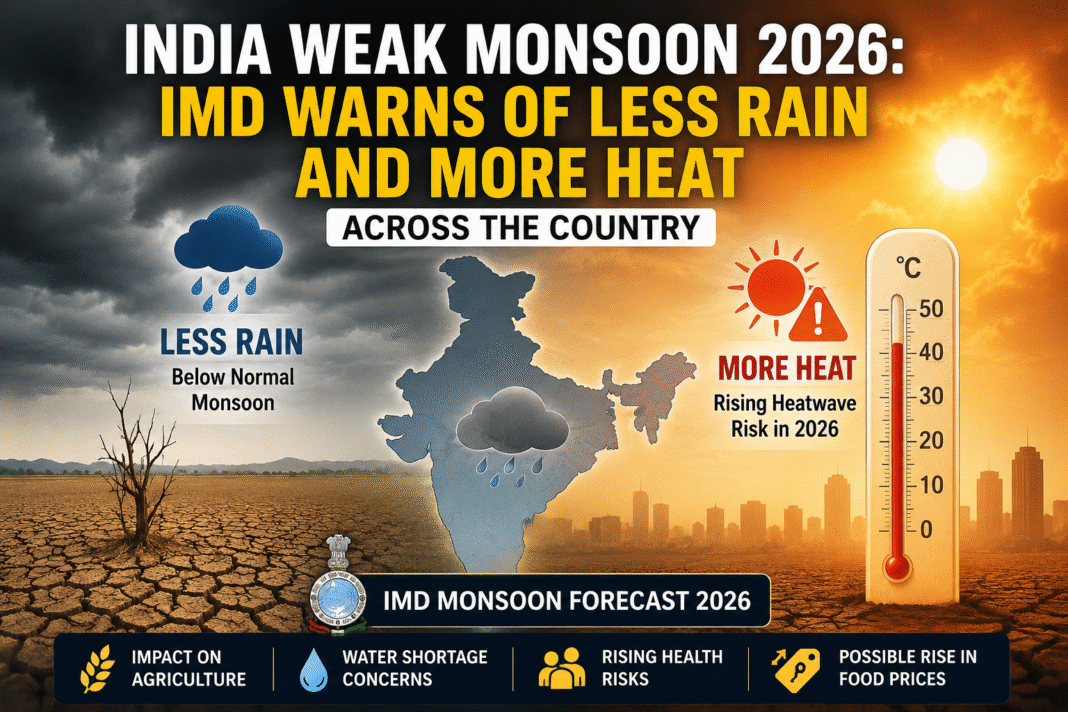
For millions of Indians, the arrival of the monsoon is more than just a change in weather—it’s a season that brings hope. Farmers wait for rain to nourish their crops, cities look forward to relief from scorching temperatures, and reservoirs depend on it to replenish water supplies. However, the latest IMD Monsoon Forecast 2026 suggests that this year’s monsoon may not bring the relief many are hoping for.
According to weather experts, India could experience below-normal rainfall in 2026, while the risk of severe heatwaves continues to grow. The warning has raised concerns about agriculture, water availability, and the overall impact on daily life.
What Does the IMD Monsoon Forecast 2026 Say?
The IMD Monsoon Forecast 2026 indicates that rainfall may remain lower than the long-term average due to developing El Niño conditions in the Pacific Ocean. Historically, El Niño has often disrupted India’s monsoon patterns, leading to reduced rainfall in several regions.
While weather forecasts can change over time, the early signs suggest that many parts of the country may receive less rain than usual. This has prompted experts and policymakers to closely monitor the situation.
Why India Weak Monsoon 2026 Matters
A weak monsoon doesn’t just affect farmers—it affects everyone. Agriculture remains a major part of India’s economy, and millions of people depend on a successful monsoon season for their livelihoods.
If the India Weak Monsoon 2026 prediction becomes reality, crop production could be affected, water reservoirs may not fill up adequately, and food prices could see an increase. Rural communities are often the first to feel the impact, but eventually the effects reach consumers across the country.
India Heatwave Risk 2026 Could Add to the Challenge
As if lower rainfall wasn’t enough, experts are also warning about a rising India Heatwave Risk 2026. Several regions have already experienced unusually high temperatures, and prolonged dry conditions could make heatwaves even more intense.
For ordinary people, this means higher electricity bills, increased water consumption, and greater health risks—especially for children, senior citizens, and outdoor workers. Hospitals and local administrations may also face added pressure during extreme heat events.
Farmers Face a Difficult Season Ahead
For India’s farmers, the combination of less rain and extreme heat creates a difficult situation. Crops need the right balance of water and temperature to grow successfully. When rainfall decreases and temperatures rise, productivity often suffers.
Many experts are encouraging farmers to adopt climate-resilient practices, improve water management, and make use of modern weather forecasting tools to reduce risks.
A Reminder of Changing Climate Patterns
The concerns surrounding India Weak Monsoon 2026 and India Heatwave Risk 2026 are also part of a larger conversation about climate change. Weather patterns across the world are becoming more unpredictable, and India is increasingly experiencing extreme weather events.
The current forecast serves as a reminder that adapting to changing climate conditions is no longer a future challenge—it’s something that requires attention today.
Looking Ahead
Although there is still uncertainty about how the season will unfold, preparation will be key. Governments, communities, and individuals can take steps to conserve water, prepare for extreme heat, and support sustainable agricultural practices.
The IMD Monsoon Forecast 2026 may be a warning, but it is also an opportunity to plan ahead. As India prepares for the possibility of a weaker monsoon and stronger heatwaves, awareness and preparedness can help reduce the impact on millions of lives.