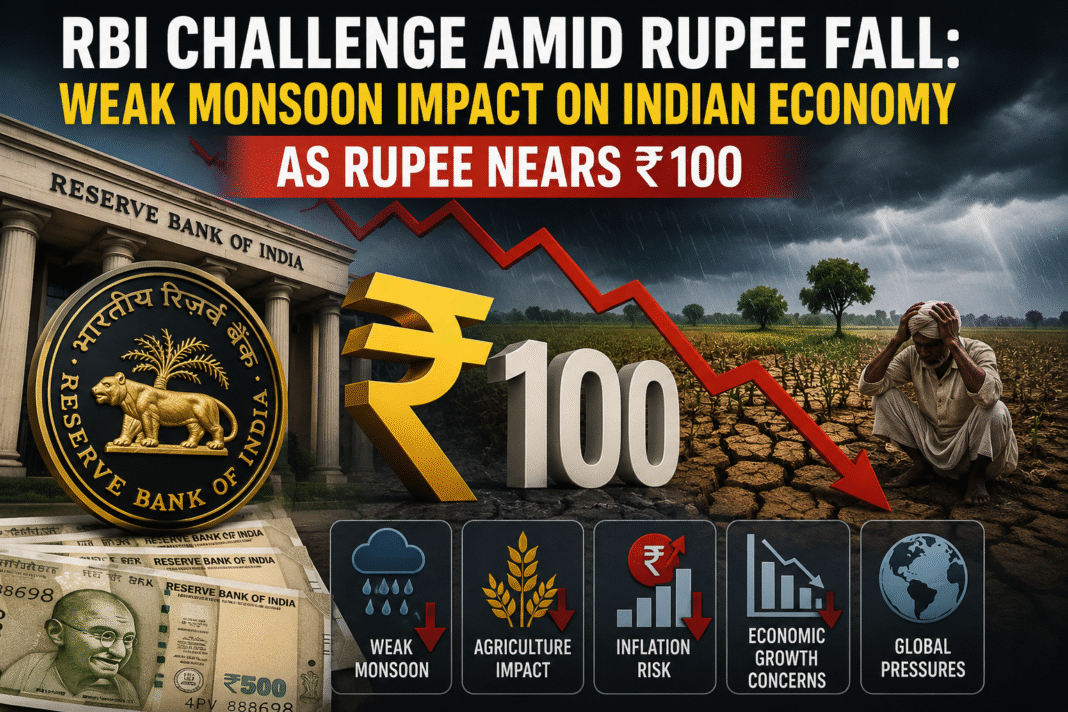
India’s economy is facing a difficult moment. On one side, the Indian Rupee is steadily losing ground against the US Dollar and is now moving closer to the ₹100 mark. On the other, weather experts are warning that the country could experience weaker-than-usual monsoon rains this year. Together, these developments are creating serious concerns for businesses, farmers, and ordinary citizens.
As the Rupee Nears ₹100, the spotlight is once again on the Reserve Bank of India (RBI). The central bank now faces the tough task of controlling inflation, supporting economic growth, and maintaining confidence in the Indian financial system. This growing RBI Challenge Amid Rupee Fall comes at a time when the potential Weak Monsoon Impact on Indian Economy could add further pressure.
Why Is the Rupee Falling?
The value of the Rupee is influenced by many factors, both within India and around the world. In recent months, a stronger US Dollar, global economic uncertainty, rising crude oil prices, and foreign investor movements have all contributed to the Rupee’s weakness.
For many people, a falling currency may seem like a distant financial issue. However, its effects are felt in everyday life. India imports a large amount of crude oil, electronics, machinery, and industrial materials. When the Rupee weakens, these imports become more expensive.
As the Rupee Nears ₹100, businesses often face higher costs, which can eventually lead to increased prices for consumers. This is one reason economists are closely monitoring the situation.
Weak Monsoon Impact on Indian Economy
While currency concerns dominate financial headlines, the weather could become an equally important factor in shaping India’s economic future.
The monsoon season is often called the lifeline of Indian agriculture. Millions of farmers depend on timely and adequate rainfall for their crops. If rainfall remains below normal, agricultural production could suffer.
The Weak Monsoon Impact on Indian Economy extends far beyond farms. Lower crop production can reduce rural incomes, affect food supplies, and push up prices of essential commodities.
A weak monsoon can lead to:
- Reduced agricultural output
- Higher food prices
- Lower rural spending
- Increased inflation
- Pressure on economic growth
For many households, rising food prices are among the most noticeable effects. From vegetables and fruits to grains and pulses, shortages often result in higher market prices.
Why This Is a Major RBI Challenge
The current situation presents a unique RBI Challenge Amid Rupee Fall because the central bank must tackle several problems at the same time.
A weaker Rupee can increase the cost of imports, especially fuel. At the same time, a weak monsoon can push food prices higher. Together, these factors can fuel inflation across the economy.
Normally, central banks raise interest rates to control inflation. However, higher interest rates can also slow borrowing, investment, and business expansion. This creates a delicate balancing act for the RBI.
The central bank must ensure that inflation remains under control without putting too much pressure on economic growth.
How the RBI Can Respond
The RBI has several options available to manage the situation.
Using Foreign Exchange Reserves
India has built substantial foreign exchange reserves over the years. The RBI can use these reserves to reduce excessive volatility in the currency market and support the Rupee when necessary.
Managing Interest Rates
Interest rates remain one of the RBI’s most powerful tools. Adjusting rates can help manage inflation and attract foreign investment, although such decisions must be carefully balanced to avoid slowing growth.
Ensuring Financial Stability
The RBI also monitors liquidity in the banking system and can take steps to maintain stability during periods of uncertainty.
These measures may not completely stop the Rupee’s decline, but they can help maintain confidence in the economy.
What It Means for Ordinary Indians
The combined impact of a weaker Rupee and poor monsoon conditions could affect everyday life in several ways.
Fuel May Become More Expensive
Since India imports most of its crude oil, a weaker Rupee increases import costs. Higher fuel prices often lead to higher transportation expenses, which can affect the prices of many products.
Food Prices Could Rise
The Weak Monsoon Impact on Indian Economy may result in lower crop yields, making food items more expensive for consumers.
Household Budgets May Come Under Pressure
When fuel, food, and imported goods become costlier, families often need to spend more on essential items. This can reduce savings and limit discretionary spending.
Are There Any Positive Aspects?
Despite the challenges, some sectors may benefit.
Indian exporters often gain when the Rupee weakens because their products become more affordable in global markets. Industries such as IT services, pharmaceuticals, textiles, and manufacturing could see increased demand from overseas buyers.
In addition, concerns about rainfall shortages often encourage investments in better irrigation systems, water conservation projects, and modern farming technologies. These improvements can strengthen agriculture in the long run.
Looking Ahead
The coming months will be crucial for India’s economy. Policymakers will closely monitor rainfall patterns, inflation data, crude oil prices, and global financial developments.
The RBI Challenge Amid Rupee Fall is not just about managing a currency. It is about protecting economic stability while ensuring that growth continues. At the same time, the actual Weak Monsoon Impact on Indian Economy will become clearer as the agricultural season progresses.