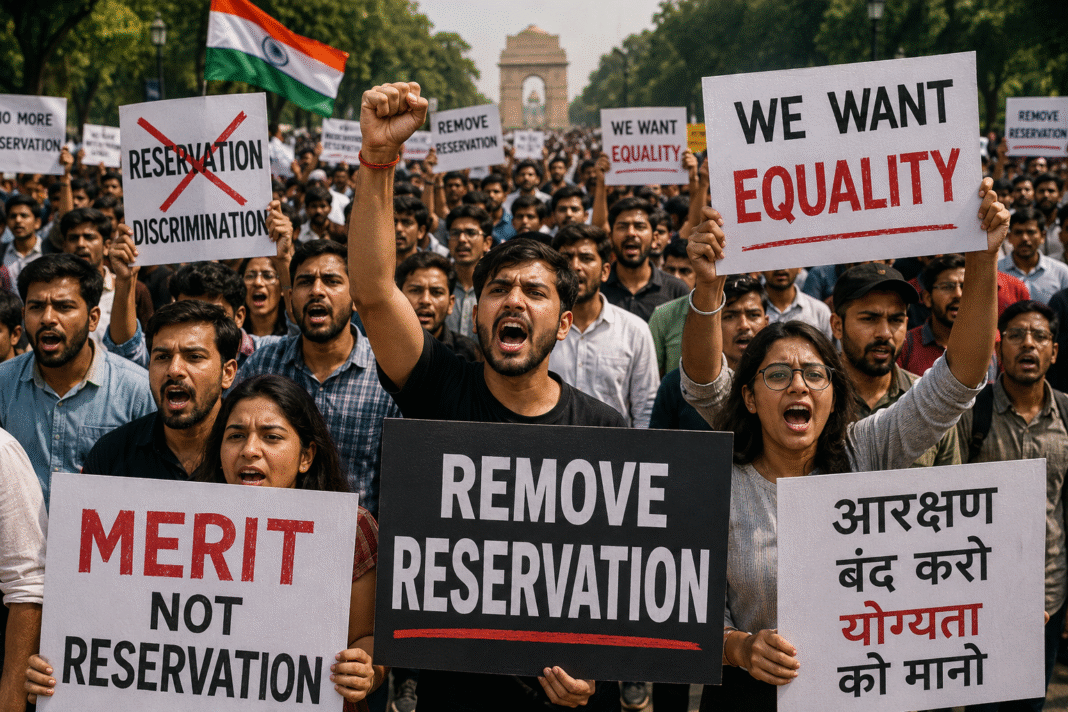
The Delhi Reservation Protest has brought the long-running debate over India’s reservation system back into the spotlight. Demonstrators took to the streets, raising the slogan “Remove Reservation” and calling for changes to the way reservation is implemented in education and government employment.
The protest has sparked conversations about merit, equal opportunities and social justice. While protesters are demanding major changes, the issue remains sensitive because reservation has been designed to provide opportunities to communities that have faced social and educational disadvantages for generations.
Protesters Take Their Demand to the Streets
The Delhi Reservation Protest saw demonstrators gathering to make their concerns heard. Many participants said they believe opportunities should be based more strongly on merit and individual performance.
Some protesters also argued that economic conditions should play a bigger role in determining who receives support. They believe that students from financially weaker families can face serious difficulties regardless of their social background.
For the protesters, the issue is not simply about opposing a particular community. Instead, they say their concern is about creating what they consider a more equal system for students and job seekers competing for limited opportunities.
Why Has the Reservation Issue Become So Sensitive?
Reservation in India is closely connected to the country’s history of social inequality and discrimination. The system was introduced to improve representation and provide opportunities to communities that have historically faced disadvantages.
Supporters of reservation believe that simply treating everyone equally today does not automatically remove the effects of disadvantages that have existed for generations. They argue that reservation can help create opportunities for communities that may otherwise remain underrepresented.
Critics, however, believe the system needs to be reviewed. They argue that some candidates face financial difficulties despite not benefiting from reservation, while others may continue to receive benefits because of their social category.
This difference in opinion is at the heart of the current debate.
Merit vs Reservation: What Are Protesters Saying?
One of the most common arguments heard during discussions around the “Remove Reservation” demand is the importance of merit.
Protesters say students work hard for competitive examinations and college admissions and should have an equal chance based on their performance. For them, competitive examinations should primarily reward preparation, ability and academic achievement.
But supporters of reservation point out that merit cannot always be separated from a person’s circumstances.
A student studying in a well-equipped school with access to coaching and other resources may have advantages that another student from a disadvantaged background does not. From this perspective, reservation is seen as a way of reducing some of those inequalities.
This makes the debate much more complicated than simply choosing between merit and reservation.
Economic Criteria Also Part of the Conversation
Another important point raised by critics of the current system is the role of economic conditions.
Some protesters believe government support should be focused more on families with limited financial resources. They argue that poverty can affect a student’s education, career opportunities and overall quality of life regardless of social background.
This argument has gained attention because education and employment have become increasingly competitive. For many young people, securing a college seat or government job can determine their future.
However, supporters of the existing reservation framework argue that economic disadvantage and social discrimination are different issues and should not automatically be treated as the same problem.
The Wider Social Impact
The Delhi Reservation Protest is taking place against the backdrop of a much larger national discussion. Reservation has remained an important social and political issue in India for decades, often generating strong opinions on both sides.
Political parties, student organisations and social groups have frequently debated whether reservation should be expanded, reduced, reviewed or restructured.
Because the subject affects education, employment and representation, even a local protest can attract wider attention. Social media can also quickly amplify statements and reactions, bringing the debate to audiences across the country.
At the same time, the sensitive nature of the issue makes peaceful demonstrations and responsible public discussion especially important.
What Could Be the Way Forward?
There is unlikely to be a simple solution to India’s reservation debate. Any major change would have to consider constitutional provisions, legal decisions, social realities and the concerns of different communities.
Rather than focusing only on whether reservation should stay or go, some experts and policymakers have also discussed broader measures to improve equality of opportunity.
Better government schools, affordable higher education, scholarships, skill development and improved access to coaching could help students from disadvantaged backgrounds compete more effectively.
At the same time, concerns about economic hardship among families outside reserved categories also deserve attention. A broader support system could potentially address financial barriers while continuing measures aimed at tackling historical social disadvantages.
What Happens Next?
The future direction of the Delhi Reservation Protest will depend on how the movement develops and whether its demands gain wider public or political support.
For now, the demonstrations have once again placed reservation at the centre of public discussion. The slogan “Remove Reservation” represents a strong demand for change from protesters, while supporters of reservation continue to argue that affirmative action remains necessary for social justice and representation.
The challenge for policymakers will be finding a balance between these competing concerns.
Conclusion
The Delhi Reservation Protest highlights how strongly people feel about the question of equal opportunity in India. Protesters demanding the removal or reform of reservation say the system should give greater importance to merit and economic circumstances.