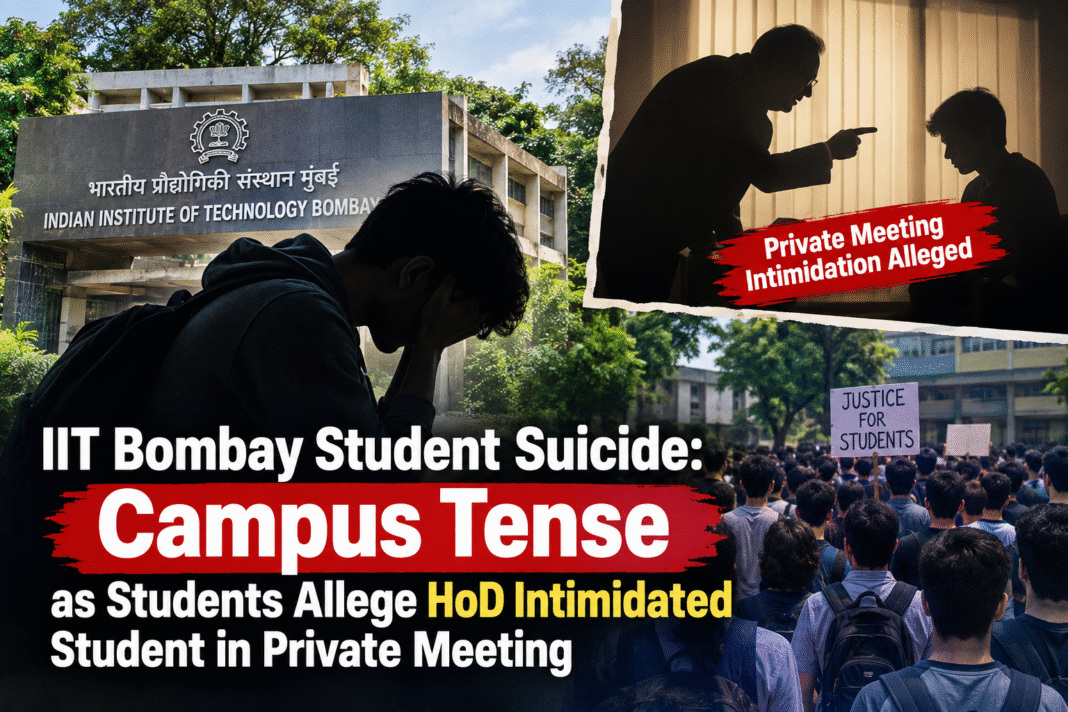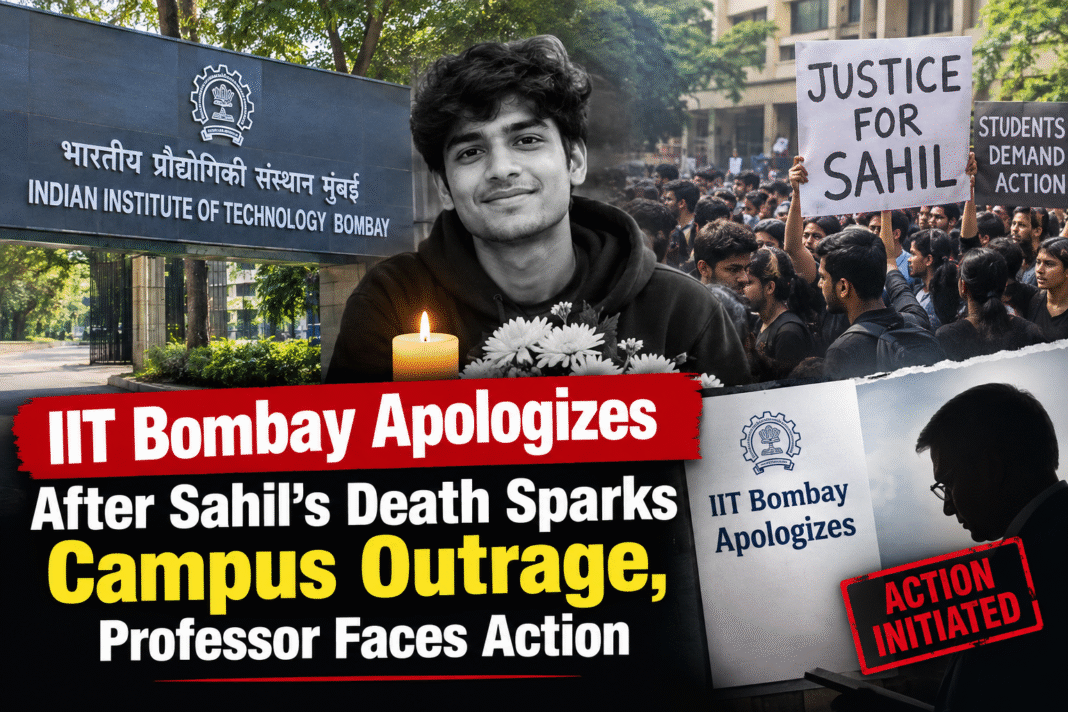
The death of IIT Bombay student Sahil Wakode has left the campus shaken and sparked strong reactions from students. What began as a tragic incident has now turned into a wider debate over student welfare, institutional accountability and the way sensitive matters are communicated.
Amid growing student protests, IIT Bombay has apologized for its earlier statement about the circumstances surrounding Sahil’s death. The institute has also removed Professor Suryanarayana Doolla from his position as Dean of Student Affairs.
The developments have added a new dimension to the IIT Bombay Student Suicide case, while the circumstances surrounding Sahil’s death continue to be investigated.
Sahil Wakode Death: What Happened?
The Sahil Wakode Death case came to light after the second-year BTech student was found dead on the IIT Bombay campus on September 18, 2026.
Sahil was studying in the Department of Energy Science and Engineering. His death came after an incident during a mid-semester examination, according to the institute’s initial communication.
IIT Bombay had said that Sahil was allegedly found using a mobile phone during the examination. The institute also said that the question paper was allegedly uploaded to ChatGPT to seek answers.
According to the initial statement, the matter was discussed with the concerned instructor, faculty adviser and Head of Department. The institute said that no formal disciplinary action had been initiated against Sahil at that stage.
However, the decision to include these details in the institute’s public statement quickly became controversial.
Why Did IIT Bombay Apologize?
The situation changed after students objected to the way the incident had been described.
Students questioned why details about an alleged examination violation were being highlighted while the circumstances surrounding Sahil’s death were still being investigated.
Following the protests and criticism, the institute issued an IIT Bombay Apology.
The institute acknowledged that it was inappropriate to characterise events leading up to Sahil’s death before those facts had been established through an investigation.
The apology was significant because it showed that the institute had reconsidered its earlier communication. It also came at a time when students were increasingly demanding answers from the administration.
For Sahil’s family and fellow students, the issue was not simply about the wording of a statement. It also raised questions about how institutions should communicate when dealing with the death of a student and an ongoing investigation.
Professor Suryanarayana Doolla Faces Action
Another major development involves Professor Suryanarayana Doolla, who was serving as Dean of Student Affairs at IIT Bombay.
The institute has removed him from the position with immediate effect.
Reports indicate that Professor Doolla continues to serve as a professor and Head of the Department of Energy Science and Engineering. Any further action is expected to depend on the findings of the investigation.
Sahil’s family has also made allegations involving the professor, including claims of harassment and caste-based discrimination. These are allegations under investigation and should not be treated as established facts unless confirmed by the relevant authorities.
The administrative action against Professor Doolla has nevertheless become one of the key developments following the student’s death.
IIT Bombay Student Protest Gains Momentum
The IIT Bombay Student Protest has become one of the most visible responses to the incident.
Students gathered on campus and raised concerns about accountability, student support and the handling of complaints involving students and faculty members.
Reports said students presented a list of demands to the administration. These reportedly included calls for greater transparency, stronger grievance-redressal mechanisms, better mental-health support and accountability in cases involving students.
The protests also reportedly affected academic activities, including mid-semester examinations.
For many students, the protests are about more than one incident. They say the case has opened a larger conversation about the pressures students face at highly competitive institutions and whether they have enough support when they are going through difficult situations.
Questions Over What Happened Before Sahil’s Death
One of the biggest questions in the case is what exactly happened between the examination incident and Sahil’s death.
The institute’s first statement provided its account of the examination-related incident. However, the full sequence of events remains subject to investigation.
That distinction is important.
At this stage, allegations made by different parties should not be confused with facts established by investigators. The ongoing investigation will be crucial in determining what happened and whether any individual or institutional actions played a role in the circumstances surrounding Sahil’s death.
IIT Bombay’s apology also recognized the importance of waiting for the investigation before drawing conclusions about the events leading up to the tragedy.
Police Case and Family’s Allegations
Reports indicate that a police case was registered following allegations made by Sahil’s family.
The reported case includes provisions under the SC/ST (Prevention of Atrocities) Act and provisions relating to abetment of suicide.
These are serious allegations, but the legal process is still underway. An FIR or complaint records allegations that authorities are required to investigate; it does not by itself establish guilt.
The investigation will therefore be important in determining the facts and deciding whether further legal action is necessary.
What About the IIT Bombay Director?
Amid the protests, reports also circulated about the possible resignation of IIT Bombay Director Professor Shireesh B. Kedare.
The institute has denied that the Director has resigned.
The clarification came as the administration faced pressure from protesting students and worked to respond to their demands.
For now, the focus remains on the investigation into Sahil’s death, the concerns raised by students and the steps being taken by the institute.
A Larger Conversation About Student Welfare
The IIT Bombay Student Suicide case has also started a wider conversation about student welfare at premier educational institutions.
Academic pressure, examinations, disciplinary procedures and relationships between students and faculty can have a significant impact on campus life. That is why students and families often expect institutions to have clear grievance mechanisms and accessible support systems.
The case has also highlighted another important issue: communication.
When a student dies and an investigation is still underway, every public statement can attract intense attention. The information released by an institution can influence how students, families and the public understand the incident.
IIT Bombay’s decision to apologize shows how quickly such communication can become part of the controversy itself.
What Happens Next?
The immediate priority remains establishing the facts surrounding Sahil’s death.
The investigation will determine the sequence of events and examine the allegations raised by his family. At the same time, IIT Bombay will have to respond to the concerns raised by students and consider whether changes are needed in its grievance, counselling and disciplinary systems.
For students on campus, the issue is ultimately about having a system where concerns can be raised safely and where sensitive situations are handled carefully.
Conclusion
The Sahil Wakode Death case has shaken IIT Bombay and led to growing demands for answers from the institute.