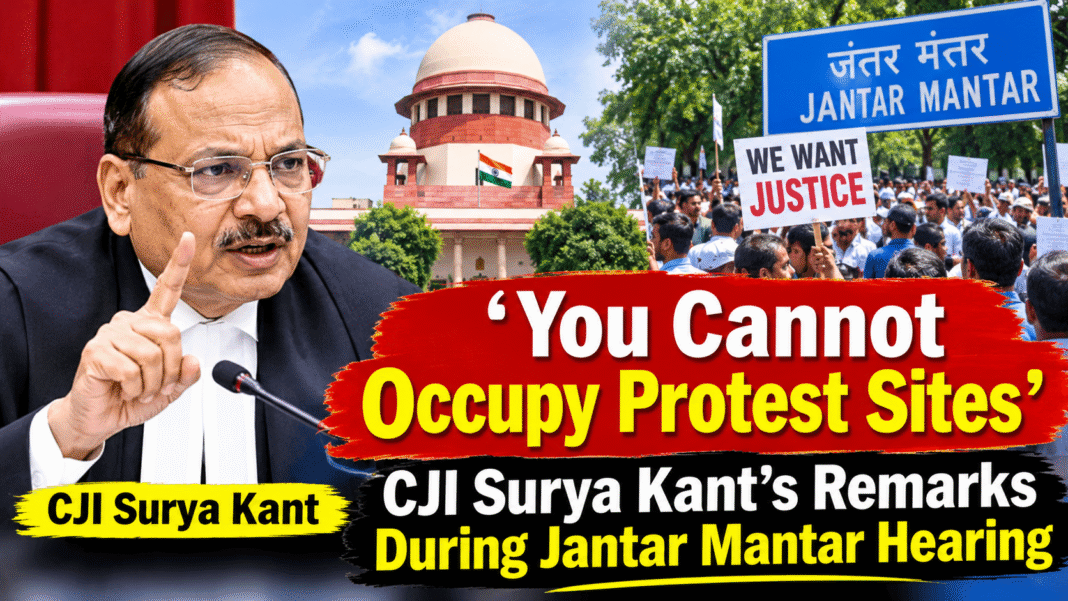
The Supreme Court has once again brought the debate over the right to protest into focus. During a hearing on November 3, 2026, Chief Justice of India (CJI) Surya Kant made an important observation that no individual or organisation can occupy a designated protest site indefinitely.
The remark, “You Cannot Occupy Protest Sites,” came during the CJI Surya Kant Jantar Mantar hearing, where the court was examining issues related to protests in Delhi, including demonstrations against Chief Election Commissioner Gyanesh Kumar.
The Chief Justice made it clear that everyone has the right to express their views and participate in peaceful demonstrations. However, one group cannot keep occupying a public protest venue for an unlimited period while preventing others from using the same space.
The hearing also brought attention to another important question: how can authorities protect the right to protest without affecting the daily lives and businesses of ordinary people?
CJI Surya Kant Says Protest Sites Cannot Be Occupied Forever
During the proceedings, CJI Surya Kant questioned the idea of allowing one organisation to occupy a designated protest location indefinitely.
He pointed out that different sections of society, including farmers, workers, journalists and trade unions, also need places to organise demonstrations and raise their concerns.
If one group continues occupying a protest venue, where will others go to exercise their democratic rights?
The Chief Justice stressed that public protest sites should be available to everyone and that demonstrations can be organised for specific periods, subject to applicable permissions and conditions.
These Supreme Court protest site remarks highlight the importance of maintaining fairness when allocating public spaces for demonstrations.
The court’s observation does not mean that protests should be stopped. Instead, it raises the question of how different groups can get an equal opportunity to express their opinions without creating unnecessary inconvenience for others.
What Happened During the Supreme Court on Jantar Mantar Protest Hearing?
The Supreme Court on Jantar Mantar protest issue came up during proceedings involving multiple petitions connected to demonstrations against Chief Election Commissioner Gyanesh Kumar.
The petitions raised several concerns, including alleged police action against protesters, detentions, restrictions on demonstrations and the difficulties faced by people because of prolonged protests.
Another major issue concerned the status of Jantar Mantar as an authorised protest location.
The Delhi Police’s decision to remove its designated protest status and shift demonstrations to alternative locations, including Ramlila Ground, Burari Ground and CBD Ground, also came under discussion.
This decision raised concerns among protesters about the availability of suitable public spaces where they could peacefully express their views.
The Supreme Court is examining the issues raised by the different parties before deciding how the matter should be addressed.
Why Did the Supreme Court Discuss the Rights of Traders?
Apart from the protesters’ concerns, the court also heard arguments about the difficulties faced by traders and local businesses.
Senior advocate Mukul Rohatgi, representing traders’ associations, explained how prolonged demonstrations can affect commercial activities.
When protests continue for several days, nearby markets may experience fewer customers. Traffic movement can become difficult, and shopkeepers may struggle to run their businesses normally.
The impact is not limited to business owners. Daily-wage workers, delivery personnel and small vendors can also lose their daily income when commercial activities are disrupted.
CJI Surya Kant acknowledged the importance of considering these concerns.
The court’s discussion highlighted that the right to protest and the right to earn a livelihood both deserve consideration. Protecting one should not mean completely ignoring the other.
Traders Seek Restrictions on Protests in Delhi
During the hearing, the Kirana Committee Delhi and other traders’ organisations raised concerns about the financial losses caused by prolonged demonstrations.
Representing the traders, Mukul Rohatgi argued that repeated protests could create difficulties for businesses, particularly during the festive season when shops depend on higher customer footfall.
The traders sought restrictions on protests and dharnas in Delhi for the next two months, irrespective of whether permission had been obtained.
They argued that demonstrations could affect shopping areas, traffic movement and the everyday activities of people living in the city.
However, the Supreme Court indicated that the matter needed careful consideration. A solution should take into account the rights of protesters as well as those of traders, workers and ordinary citizens.
The bench also asked the traders’ organisations to include the protest organisers as parties to their petition so that their views could be heard.
What Did Delhi Police Tell the Supreme Court?
Solicitor General Tushar Mehta, appearing for the Centre and Delhi Police, presented the authorities’ position during the hearing.
He submitted that permission for a protest held on July 20 had been granted for only one day. However, according to his submission, protesters continued occupying the site for 17 days.
He also raised concerns about a subsequent march towards Parliament, arguing that it required separate permission.
On the other hand, lawyers representing the protesters raised concerns about alleged police excesses, detentions and restrictions during the demonstrations.
These are competing submissions made before the court and remain subject to judicial consideration.
Does the Constitution Allow People to Protest in India?
Yes. The right to peaceful protest is an important part of India’s democratic system.
Under Article 19(1)(b) of the Indian Constitution, citizens have the fundamental right to assemble peacefully and without arms.
This allows people to organise demonstrations, public meetings and protests to express their opinions or raise concerns about government decisions.
However, this right is not unlimited.
Article 19(3) allows reasonable restrictions on peaceful assembly in the interests of public order and the sovereignty and integrity of India.
The Supreme Court has also discussed similar issues in the 2020 Shaheen Bagh case. The court observed that public roads and spaces cannot be occupied indefinitely in a manner that causes inconvenience to other people.
The latest CJI Surya Kant latest news has brought these constitutional questions back into discussion, especially the issue of how designated protest locations should be managed.
Why Are CJI Surya Kant’s Remarks Important?
The Supreme Court protest site remarks are important because they address a situation that affects both protesters and ordinary citizens.
India is a democracy where people must have the freedom to disagree, question decisions and raise their voices against issues they believe are important.
At the same time, cities like Delhi cannot stop functioning whenever a public demonstration takes place.
Markets need customers, workers need their daily income, commuters need roads and residents need access to their neighbourhoods.
The court’s observations highlight the need for a practical arrangement where peaceful demonstrations can take place without unnecessarily disturbing other people’s lives.
It also raises an important question about whether authorities should establish clear rules regarding protest permissions, time limits and the availability of alternative venues.
What Happens Next in the Jantar Mantar Protest Case?
The Supreme Court is examining several issues connected to the Jantar Mantar protest controversy, including the status of the protest site, allegations of police action and the concerns raised by traders.
The court will consider the submissions made by the Centre, Delhi Police, traders’ organisations and protest organisers before proceeding further.
The Jantar Mantar protest news has once again started a wider conversation about the balance between democratic rights and public convenience.
The outcome of the proceedings could also be important for how authorities manage designated protest locations in the future.
Conclusion
The CJI Surya Kant Jantar Mantar hearing has highlighted an important issue concerning the use of public spaces in a democracy.
With his observation, “You Cannot Occupy Protest Sites,” the Chief Justice underlined that no single group can claim permanent control over a designated protest venue.