Imagine being forced to leave your home overnight, watching your village burn and losing loved ones without knowing whether you will ever see them again. This is the reality thousands of Rohingya families faced during the violence in Myanmar in 2017.
Nearly nine years later, the suffering of the Rohingya community is once again at the centre of international attention. The International Court of Justice (ICJ) is set to deliver its judgment today, November 19, 2026, in a landmark genocide case against Myanmar.
The case focuses on allegations of mass killings, sexual violence, destruction of villages and the forced displacement of hundreds of thousands of Rohingya Muslims. More than 700,000 people fled to neighbouring Bangladesh during the 2017 military crackdown, leaving behind their homes, belongings and, in many cases, family members.
But what exactly happened in Myanmar? Why has The Gambia taken the country to the world’s highest court? And what could today’s judgment mean for the Rohingya people who are still waiting for justice?
Let’s understand the case and why it matters.
Who Are the Rohingya and What Happened in Myanmar?
The Rohingya are a predominantly Muslim ethnic minority who have lived for generations in Myanmar’s Rakhine State. Despite their long history in the region, they have faced discrimination, restrictions and difficulties in obtaining citizenship for decades.
Myanmar’s 1982 Citizenship Law effectively excluded most Rohingya from citizenship, leaving many without official nationality. As a result, they have faced restrictions on their movement, education, healthcare and employment.
Tensions reached a breaking point in August 2017. Following attacks by the Arakan Rohingya Salvation Army (ARSA), an armed group, Myanmar’s military launched a major security operation in Rakhine State.
However, what followed went far beyond a conventional security operation, according to international investigations and survivor accounts.
Rohingya families reported that soldiers entered villages, homes were set on fire, civilians were killed and women and girls experienced sexual violence. Entire communities were forced to flee as violence spread across the region.
For many survivors, crossing the border into Bangladesh was the only way to escape.
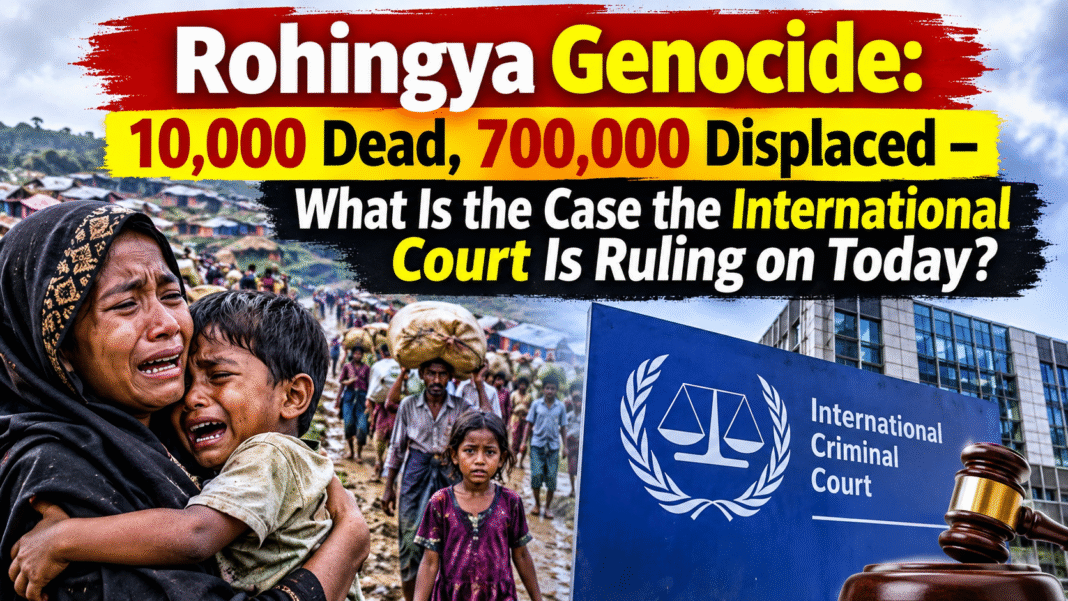
10,000 Dead and 700,000 Displaced: The Human Cost of the Crisis
The scale of the Rohingya crisis shocked the world.
Estimates suggest that around 10,000 Rohingya may have been killed during the violence, although the exact death toll remains disputed and difficult to establish. International investigations have documented widespread killings, sexual violence, torture and the destruction of civilian settlements.
More than 700,000 Rohingya crossed into Bangladesh following the 2017 crackdown. Many settled in refugee camps in Cox’s Bazar, which eventually became home to one of the world’s largest refugee populations.
But escaping Myanmar did not mean the end of their struggles.
Even today, many Rohingya families live in overcrowded camps, facing uncertainty about their future. Access to education, healthcare, employment and basic facilities remains a serious concern.
For children growing up in these camps, the idea of a normal childhood often feels distant. Many have never experienced life outside a refugee settlement or have little memory of the homes their families were forced to leave.
The crisis is therefore not just about what happened in 2017. It is also about the millions of people whose lives continue to be affected by displacement and statelessness.
Why Is The Gambia Taking Myanmar to the ICJ?
In November 2019, The Gambia filed a case against Myanmar at the International Court of Justice, accusing the country of violating the 1948 Genocide Convention.
The move attracted international attention because The Gambia is thousands of kilometres away from Myanmar and has no direct territorial connection to the Rohingya crisis.
So why did it get involved?
The Gambia brought the case with support from the Organisation of Islamic Cooperation (OIC). Its argument is that Myanmar failed to fulfil its international obligations to prevent and punish genocide and that the treatment of the Rohingya violated the Genocide Convention.
The case, officially known as The Gambia v. Myanmar, asks the ICJ to examine whether Myanmar is legally responsible for the alleged genocidal acts.
The Gambia has also sought measures to protect the Rohingya population, preserve evidence and ensure accountability for the violations.
The case is important because it shows that countries can raise concerns about alleged violations of the Genocide Convention even when the affected population lives outside their borders.
What Is the International Court of Justice Deciding Today?
The ICJ is not a criminal court trying individual soldiers or military commanders. Instead, it deals with disputes between countries and determines whether a state has violated its international legal obligations.
In this case, judges must examine whether Myanmar violated the Genocide Convention through its treatment of the Rohingya population.
One of the most important questions is whether the violence involved genocidal intent.
Under international law, genocide does not simply mean mass killing. It requires proof that certain acts were committed with the specific intention of destroying, in whole or in part, a national, ethnic, racial or religious group.
The court will therefore consider evidence relating to killings, serious physical and mental harm, living conditions imposed on the Rohingya and other alleged acts.
The Gambia argues that the pattern and scale of violence demonstrate an intention to destroy the Rohingya, at least in part.
Myanmar, meanwhile, has rejected the genocide allegations and maintained that its 2017 operations were security measures carried out in response to attacks by armed militants.
The judges must assess the evidence and legal arguments before reaching their decision.
How Did the Rohingya Genocide Case Reach This Stage?
The legal battle has taken several years.
In January 2020, the ICJ ordered Myanmar to take provisional measures to protect the Rohingya from acts prohibited under the Genocide Convention. The court also directed Myanmar to preserve evidence related to the allegations.
In July 2022, the court rejected Myanmar’s preliminary objections, allowing the case to move forward.
The proceedings later included submissions and interventions from several other countries interested in the interpretation of the Genocide Convention.
Public hearings on the merits took place from January 12 to January 29, 2026, at the Peace Palace in The Hague, Netherlands.
After hearing the arguments, the judges began their deliberations. The court subsequently announced November 19, 2026, as the date for delivering its judgment.
Why Does Today’s Judgment Matter?
For the Rohingya community, this case is about much more than a legal decision. It is about recognition, dignity and the hope that those responsible for the suffering of their families may one day be held accountable.
A judgment finding Myanmar responsible for violations of the Genocide Convention could become an important moment in international law. It could also strengthen calls for reparations, accountability and better protection for the Rohingya.
However, a court ruling alone cannot solve every problem.
The ICJ does not have its own enforcement force, and implementing its judgments can depend on international cooperation. It also cannot sentence individual military officials. That responsibility belongs to separate criminal justice proceedings.
For refugees living in Bangladesh, the biggest questions remain unchanged: When will they be able to return home safely? Will they receive citizenship and equal rights? And will their children have the opportunity to grow up without fear?
What Happens Next for the Rohingya?
Whatever the outcome of the ICJ proceedings, the Rohingya crisis will require continued international attention.
More than 700,000 people who fled Myanmar in 2017 have been living with the consequences of displacement for years. Many want to return to their homeland, but any return must be safe, voluntary and dignified, with proper guarantees of security and basic rights.
The international community will also need to continue supporting refugees in Bangladesh and addressing the conditions that forced the Rohingya to leave Myanmar in the first place.
Conclusion
The Rohingya genocide case is a reminder that the consequences of mass violence do not end when the headlines disappear.