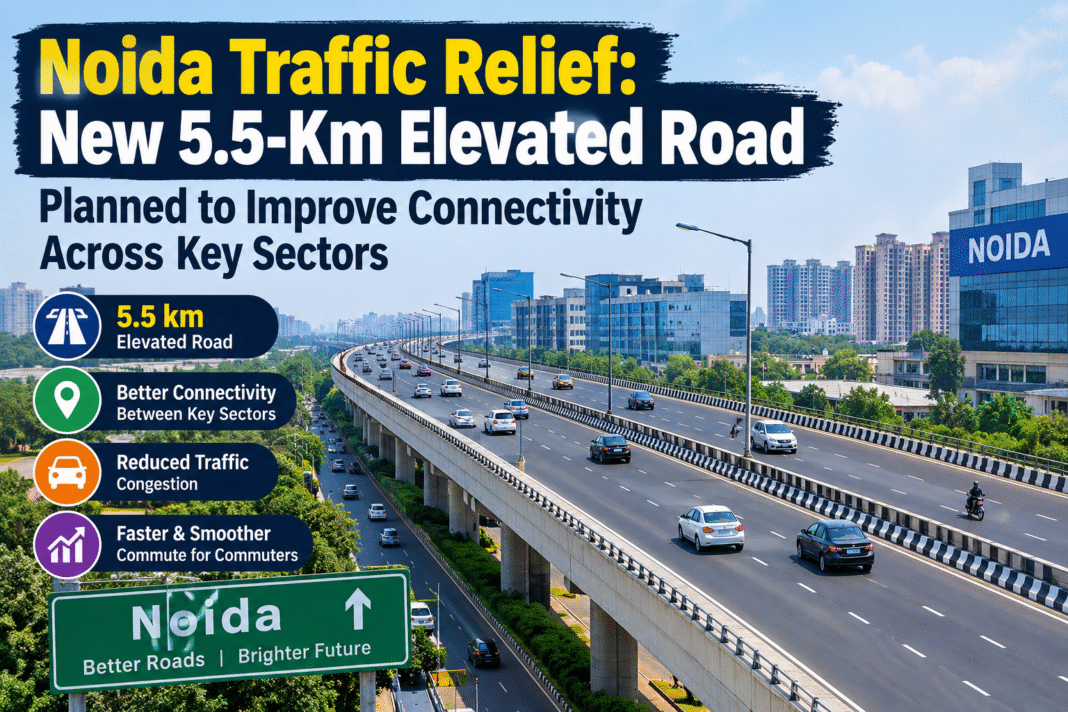
Noida may soon get some much-needed relief from its growing traffic problems. A new 5.5-km elevated road has been proposed between Sector 3 and Sector 60, with the aim of making travel smoother across several important parts of the city.
The proposed road is expected to provide an alternative route for commuters who currently spend a significant amount of time stuck at busy intersections and congested stretches. The project is being planned by the Noida Authority, while IIT Roorkee has been involved in studying the alignment.
If the project moves ahead as planned, it could become an important addition to Noida’s growing road infrastructure.
Where Will the New Elevated Road Come Up?
The proposed Noida elevated road will begin near the Rajnigandha Underpass in Sector 3 and extend towards Sector 60.
The road is expected to be around 5.5 km long and six lanes wide. The alignment has been reviewed to ensure that the elevated section does not simply shift the traffic problem from one location to another.
Initially, there was a proposal to bring the elevated road down around Sector 57. However, studies reportedly indicated that this could put additional pressure on roads around Sectors 57 and 58.
The plan was therefore changed, with the elevated road now proposed to continue up to Sector 60.
Which Areas Could Benefit?
One of the biggest advantages of the project could be better connectivity between several residential, commercial and industrial areas.
The proposed corridor will provide easier movement towards areas including Sectors 59, 60, 62 and 63. It could also improve connectivity towards Ghaziabad, which is an important destination for thousands of daily commuters.
For people travelling through Noida during peak hours, having a dedicated elevated corridor could mean less time spent waiting at busy crossings and surface-level roads.
Why Does Noida Need Another Elevated Road?
Noida has changed rapidly over the last few years. New housing societies, offices, shopping areas and commercial centres have brought more people and vehicles onto the city’s roads.
As traffic volumes continue to increase, several major roads become particularly busy during the morning and evening rush hours.
An elevated road can help by separating through-traffic from vehicles using local roads. Instead of every vehicle travelling through the same ground-level intersections, some traffic can use the elevated corridor and move more directly towards its destination.
This is the main reason the proposed Noida Traffic Relief project is being seen as an important infrastructure development.
IIT Roorkee Involved in the Planning
The alignment study for the proposed road has been carried out with the involvement of IIT Roorkee. The next important step is the preparation of the Detailed Project Report (DPR).
The DPR will provide a clearer picture of the project’s design, construction requirements, estimated cost and other technical details.
This stage is important because the success of an elevated road depends not only on its length but also on how effectively its ramps, entry points, exit points and connecting roads are designed.
Better Connectivity Towards Sector 62 and Ghaziabad
The proposed connection to Sector 60 could be particularly useful for commuters heading towards Sector 62, Sector 63 and Ghaziabad.
These areas see heavy movement of office workers, residents and commercial vehicles every day. During peak hours, even a small traffic bottleneck can result in long queues and significant delays.
A well-designed elevated corridor could provide an additional route and reduce pressure on existing roads.
The project could also improve the overall connectivity between central Noida and the northern parts of the city.
What Could Change for Daily Commuters?
For regular commuters, the biggest benefit would likely be smoother and more predictable travel.
If traffic is successfully diverted onto the elevated road, people travelling between different sectors may spend less time at congested intersections.
The project could potentially offer:
- Faster movement between key sectors
- Reduced pressure on busy surface roads
- Better connectivity to Sectors 59, 60, 62 and 63
- Easier movement towards Ghaziabad
- Improved traffic flow during peak hours
- An additional route for through-traffic
However, the actual impact will depend on how the project is designed and connected to the existing road network.
Proper Planning Will Be the Key
Building an elevated road does not automatically solve every traffic problem. In many cities, congestion can simply move to the points where elevated roads begin or end.
That is why the decision to extend the proposed corridor towards Sector 60 is important. A carefully planned connection could prevent the creation of another major bottleneck at the end of the elevated section.
The ramps, service roads and junctions will need to be designed in a way that allows traffic to merge smoothly with existing roads.
Another Step Towards Better Noida Connectivity
The proposed 5.5-km elevated road from Sector 3 to Sector 60 could become a major part of Noida’s future traffic management strategy.
With a planned six-lane corridor and connections to several important sectors, the project has the potential to make everyday travel easier for thousands of commuters.
For now, the project is still in the planning stage, and the Detailed Project Report will provide more clarity on its cost, design and construction timeline.
If the project receives the necessary approvals and is implemented properly, the new elevated road could offer much-needed Noida traffic relief and strengthen connectivity between central Noida, key sectors and neighbouring Ghaziabad.