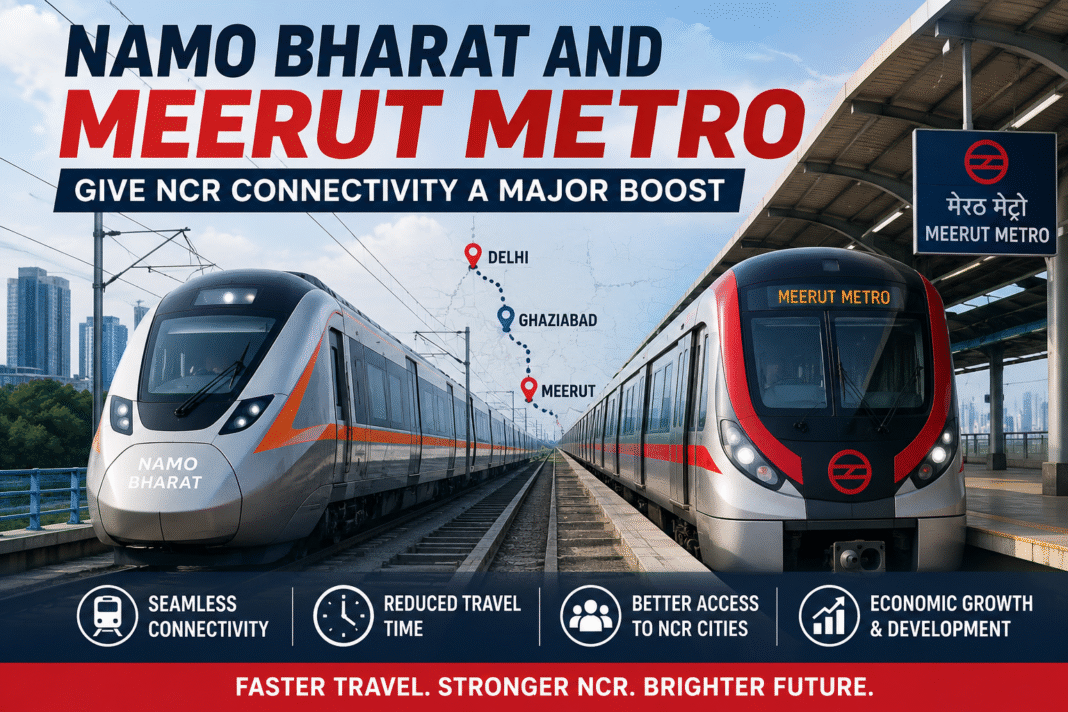
Travel between Delhi, Ghaziabad and Meerut is becoming easier and faster with the expansion of modern public transport. The Namo Bharat and Meerut Metro network is emerging as a major development for the National Capital Region (NCR), giving commuters a faster alternative to long road journeys.
For years, travelling between Delhi and Meerut often meant dealing with traffic, crowded roads and unpredictable travel times. The arrival of the Namo Bharat regional rail service has changed that experience for many passengers.
At the same time, the Meerut Metro is improving connectivity within the city. Together, these services are creating a transport system that connects local neighbourhoods with the wider NCR.
Namo Bharat Makes Delhi-Meerut Travel Easier
The Delhi-Ghaziabad-Meerut corridor is one of the most important regional transport projects in the NCR. Stretching around 82 kilometres, the corridor connects Delhi with major locations in Ghaziabad and Meerut.
The Delhi Meerut Namo Bharat service is designed for people who need to travel longer distances quickly. Instead of spending hours on busy roads, commuters now have the option of using a fast regional rail service.
For professionals who work in Delhi but live in Meerut, this can make a significant difference. Students, business owners and people travelling for regular appointments can also benefit from better connectivity.
The Namo Bharat RRTS is therefore not just another rail service. It is designed to connect different cities of the NCR more efficiently and make regional commuting more practical.
Meerut Metro Improves Local Travel
While Namo Bharat focuses on connecting cities, the Meerut Metro is designed to make travelling within Meerut easier.
This is particularly useful for passengers who need to reach different parts of the city after arriving in Meerut. Instead of depending completely on buses, autos, taxis or private vehicles, commuters have another public transport option.
One of the most interesting aspects of the project is that the Meerut Metro and Namo Bharat services use the same infrastructure. This creates a combination of regional and local transportation that can make the overall journey more convenient.
For passengers, the idea is simple: Namo Bharat for faster regional travel and Meerut Metro for local connectivity.
Delhi, Ghaziabad and Meerut Come Closer
The biggest impact of the Delhi Ghaziabad Meerut corridor could be the way it brings these cities closer together.
Delhi is a major centre for jobs, education and business. Ghaziabad has grown rapidly as a residential and commercial city, while Meerut is an important industrial, educational and trading centre in western Uttar Pradesh.
Better transportation between these cities means people may have more freedom when choosing where to live, work or study.
For example, someone living in Meerut may be able to consider a job in Delhi without worrying as much about the difficulties of road travel. Similarly, businesses in Meerut and Ghaziabad can benefit from easier access to a larger workforce and customer base.
In the long run, this could make the three cities feel more like connected parts of one larger economic region.
Could Namo Bharat Help Reduce Traffic?
Traffic congestion has become a daily problem across Delhi-NCR. Roads connecting Delhi, Ghaziabad and Meerut can become heavily crowded, particularly during peak hours.
A strong regional public transport system can give commuters a reason to leave their cars and two-wheelers at home.
The more passengers who choose Namo Bharat and Metro services, the greater the possibility of reducing the number of private vehicles on major roads.
This could have several benefits, including less traffic, lower fuel consumption and potentially better air quality.
However, the real impact will depend on how many people eventually shift from private transportation to public transport and how well the different transport systems are connected.
A Boost for Meerut’s Growth
Better connectivity can also change the economic landscape of a city.
The Namo Bharat Meerut connection could make areas around stations more attractive for housing, offices, shops and other businesses. People who previously preferred living closer to Delhi because of commuting concerns may now consider Meerut and nearby areas.
Improved connectivity can also encourage businesses to expand outside the central parts of NCR.
As travel becomes easier, commercial activity around transport hubs may increase. Restaurants, retail stores, offices and residential projects could benefit from a growing number of daily passengers.
This is one reason why major transportation projects often have an impact far beyond the railway tracks themselves.
One Network, Different Travel Needs
One of the strongest features of the project is its ability to serve different types of passengers.
Someone travelling from Delhi to Meerut needs a fast regional service with fewer stops. On the other hand, someone travelling within Meerut may need a Metro service with more stations.
The integrated system allows both requirements to be addressed through the same transport infrastructure.
This approach can also make public transport more attractive because passengers can potentially combine regional and local journeys instead of depending on multiple road-based options.
For a rapidly growing region like NCR, this type of integrated transportation could become increasingly important.
Better Connectivity for Students and Professionals
The benefits of the Delhi Meerut Namo Bharat service are not limited to office commuters.
Students travelling between cities for education, professionals attending meetings, business owners visiting clients and families travelling for personal reasons can all benefit from improved regional connectivity.
A faster connection can also make day trips between Delhi and Meerut more practical.
Over time, better connectivity may encourage greater interaction between educational institutions, businesses and communities across the NCR.
What Lies Ahead for NCR?
The development of the Namo Bharat RRTS network is part of a larger effort to improve regional transportation around Delhi.
As NCR continues to expand, connecting cities such as Noida, Greater Noida, Ghaziabad, Meerut, Gurugram and Faridabad will become increasingly important.
The success of the Delhi-Ghaziabad-Meerut corridor could encourage similar regional transport projects in other parts of the NCR.
The long-term goal is not simply to build faster trains. It is to create a transportation network where people can move between cities without having to depend heavily on private vehicles.
Conclusion
The Namo Bharat and Meerut Metro are changing the way people think about travelling between Delhi, Ghaziabad and Meerut.
The Delhi Ghaziabad Meerut corridor offers faster regional connectivity, while the Meerut Metro provides better local travel options. Together, they can make daily commuting easier and support the economic growth of the region.