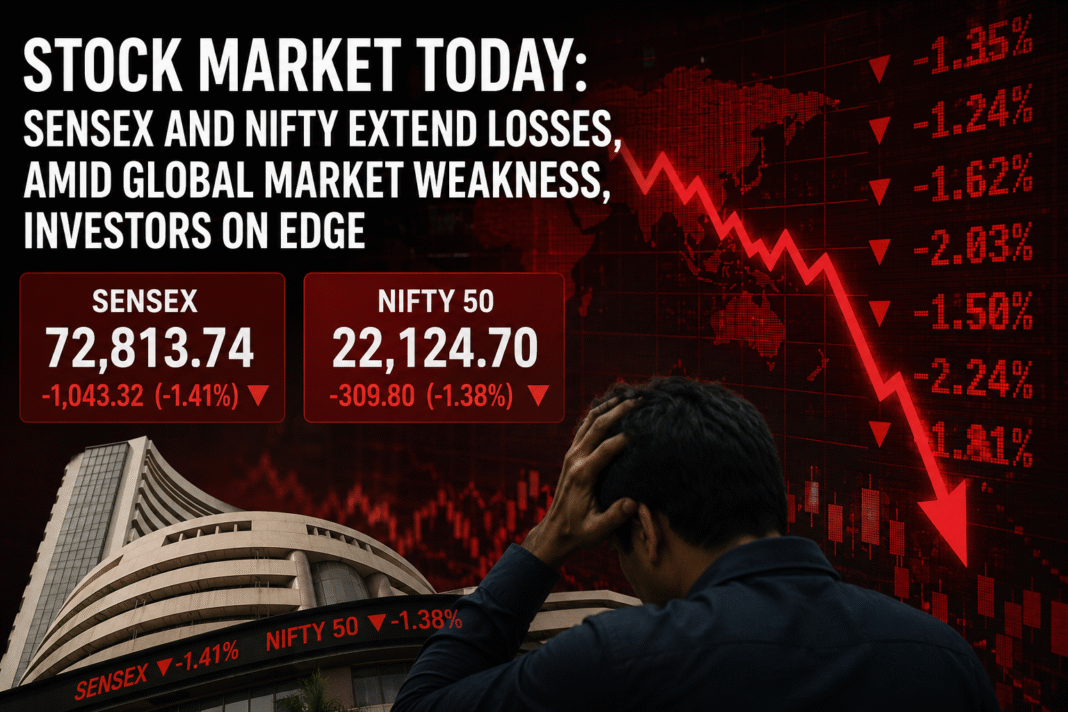
Stock Market Today: Sensex and Nifty Extend Losses as Global Market Weakness Keeps Investors Cautious
The Indian Stock Market witnessed another challenging trading session as Sensex and Nifty Extend Losses, reflecting growing concerns over Global Market Weakness. From the opening bell, investors remained cautious as weak international cues, rising crude oil prices, and uncertainty surrounding global interest rates weighed heavily on market sentiment.
For many investors, especially those who closely track Sensex Today and Nifty Today, the day served as another reminder that financial markets are influenced not only by domestic developments but also by events unfolding across the world.
According to the latest Stock Market News India, selling pressure was visible across several key sectors, including banking, information technology, auto, and metals. While a few defensive stocks managed to stay in positive territory, the overall mood in the market remained cautious.
Why Did the Indian Stock Market Fall Today?
The decline wasn’t triggered by a single event. Instead, it was the result of several global and domestic factors coming together at the same time.
Global Market Weakness Continues to Impact Investors
The biggest reason behind today’s decline is the ongoing Global Market Weakness. Major international markets have been struggling due to concerns about slowing economic growth, persistent inflation, and uncertainty over future interest rate decisions by central banks.
When global markets turn negative, the impact is often felt in the Indian Stock Market as well. Investors become more cautious, reduce exposure to riskier assets, and wait for clearer economic signals before making fresh investments.
Foreign Investors Remain Cautious
Foreign Institutional Investors (FIIs) continued to sell Indian equities, adding further pressure on benchmark indices.
FIIs play a significant role in the Indian equity market, and their investment decisions often influence market direction. Continuous selling by foreign investors usually results in increased volatility, particularly in large-cap stocks that make up the Sensex and Nifty.
Higher Crude Oil Prices Add to Market Pressure
Another major concern is the steady rise in global crude oil prices. Since India imports a large portion of its crude oil requirements, higher prices increase the country’s import bill and may contribute to inflation.
Rising fuel costs also increase operating expenses for businesses, which can eventually affect corporate earnings. This naturally makes investors more cautious.
Interest Rate Uncertainty
Investors across the globe are closely watching central banks for clues about future interest rate decisions.
If interest rates remain higher for an extended period, borrowing becomes more expensive for both businesses and consumers. This can slow economic growth and reduce corporate profitability, which ultimately affects stock market performance.
How Sensex Today and Nifty Today Performed
Throughout the trading session, both benchmark indices remained under pressure.
Sensex Today witnessed broad-based selling, with heavyweight banking and IT stocks contributing significantly to the decline. Similarly, Nifty Today also ended lower as investors preferred booking profits instead of making fresh purchases.
Although a few healthcare and FMCG companies managed to attract buying interest, they could not offset the weakness seen across other sectors.
Sector-Wise Performance
IT Stocks Continue to Face Pressure
Technology companies remained among the biggest losers of the day. Since many Indian IT firms depend heavily on international markets, concerns about slowing global demand have affected investor confidence.
Banking Stocks Witness Profit Booking
Banking stocks also traded lower as investors locked in recent gains. The sector remains sensitive to changes in global interest rates and foreign investment flows.
Auto and Metal Stocks Slip
Automobile and metal companies were also under pressure due to concerns about slowing manufacturing activity and weaker demand across international markets.
Defensive Stocks Offer Some Stability
Healthcare, pharmaceutical, and FMCG companies performed relatively better as investors shifted towards businesses that generally remain stable during uncertain economic conditions.
What Does This Mean for Investors?
Market corrections often create anxiety, especially for new investors. However, experienced market participants understand that volatility is a normal part of investing.
Instead of reacting emotionally to daily fluctuations, experts recommend focusing on long-term financial goals.
Some practical tips include:
- Continue investing through SIPs if you are a mutual fund investor.
- Maintain a diversified portfolio across different sectors.
- Avoid panic selling during temporary market corrections.
- Focus on fundamentally strong companies with consistent earnings.
History has shown that quality businesses often recover once market sentiment improves.
What Experts Are Saying
According to market analysts, the current weakness is largely driven by external factors rather than any major problem within India’s economy.
India continues to enjoy several long-term growth drivers, including:
- Strong domestic consumption
- Government infrastructure spending
- Expanding manufacturing sector
- Rapid digital transformation
- Stable banking system
- Growing investor participation
These factors continue to support the long-term outlook of the Indian Stock Market, even if short-term volatility persists.
What Should Investors Watch Next?
The direction of the market over the coming weeks will largely depend on several important developments, including:
- Global inflation data
- US Federal Reserve policy decisions
- RBI monetary policy updates
- Foreign Institutional Investor activity
- Corporate quarterly earnings
- Crude oil price movements
- Global geopolitical developments
Positive news on any of these fronts could improve investor confidence and help stabilize the market.
Outlook for the Indian Stock Market
Although Sensex and Nifty Extend Losses in today’s session, many analysts believe that India’s long-term growth story remains intact.
Short-term volatility is likely to continue as Global Market Weakness persists, but investors with patience and a disciplined investment strategy often find opportunities during such corrections.
Rather than trying to predict every market movement, investors are encouraged to focus on building a strong portfolio that can withstand temporary ups and downs.
Conclusion
Today’s Stock Market Today update reflects the cautious mood among investors as Sensex and Nifty Extend Losses amid continuing Global Market Weakness. Weak global cues, foreign investor selling, rising crude oil prices, and uncertainty over interest rates have all contributed to the recent decline.